YOUR AMAZING HEART :)
LINK: http://popplet.com/app/#/215145
Saturday, March 3, 2012

Thursday, February 9, 2012
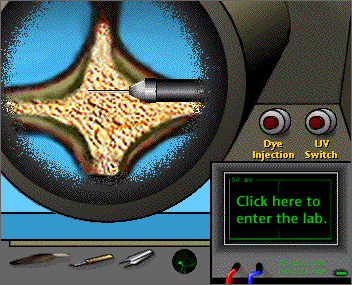
Nervous System: The Virtual Neurophysiology Lab
During the lab online:
~The 1st step was too catch and anesthetize the leech in 20% ethanol solution.
~The 2nd step was too pin the animal dorsal side up through the anterior and posterior suckers onto a dissection tray, by stretching the animal in the process.
~The 3rd step was too make a cut in the skin along the mid-line on the dorsal surface using scissors.
~The 4th step was too carefully remove the gut and other internal structures to expose the ventrally located nerve cord.
~The 5th step was too cut a window in the body wall underneath a ganglion.
~The 6th step was too isolate a section of the animal by making two parallel cuts across the animal.
~The 7th step was too cut the sinus with an ultra fine scalpel and then tease apart the sinus.
~ The 8th step was too click the Micromanipulator tip to probe the cell.
~The 9th step was too visualize the morphology of the neuron.
~The last sep was too identify the cell, which was a cell type N.
Materials:
Feather, Probe, Forceps, Scissors, Pins, Scalpel, Dissection Tray, Leech Tank, 20% Ethanol, Lech Tongs, Dissection Microscope, Micromanipulator, Oscilloscope, and a Leech.
By doing this lab I learned more about the nervous system, and the different cell types. The nervous system of the leech consists of the brain, the ventral cord, and ganglia which is located in each segment along the nerve cord. The leech is a member of the phylum Annelida or segmented worms. These worms are classified by having bodies divided into similar parts or segments. The different cell types in this lab was N, T, P, R, X, which are No Stimuli, Feather, Probe, Forceps, and Dyed Cell.

~The 1st step was too catch and anesthetize the leech in 20% ethanol solution.
~The 2nd step was too pin the animal dorsal side up through the anterior and posterior suckers onto a dissection tray, by stretching the animal in the process.
~The 3rd step was too make a cut in the skin along the mid-line on the dorsal surface using scissors.
~The 4th step was too carefully remove the gut and other internal structures to expose the ventrally located nerve cord.
~The 5th step was too cut a window in the body wall underneath a ganglion.
~The 6th step was too isolate a section of the animal by making two parallel cuts across the animal.
~The 7th step was too cut the sinus with an ultra fine scalpel and then tease apart the sinus.
~ The 8th step was too click the Micromanipulator tip to probe the cell.
~The 9th step was too visualize the morphology of the neuron.
~The last sep was too identify the cell, which was a cell type N.
Materials:
Feather, Probe, Forceps, Scissors, Pins, Scalpel, Dissection Tray, Leech Tank, 20% Ethanol, Lech Tongs, Dissection Microscope, Micromanipulator, Oscilloscope, and a Leech.
By doing this lab I learned more about the nervous system, and the different cell types. The nervous system of the leech consists of the brain, the ventral cord, and ganglia which is located in each segment along the nerve cord. The leech is a member of the phylum Annelida or segmented worms. These worms are classified by having bodies divided into similar parts or segments. The different cell types in this lab was N, T, P, R, X, which are No Stimuli, Feather, Probe, Forceps, and Dyed Cell.
Thursday, February 2, 2012
PowerPoint of the Sense of Smell
This slide show represents how your sense of smell works, and how you use it in your daily lives. We are surrounded by different smells all of the time.
Monday, December 19, 2011
Research Article
The article, Extra calcium won't lower bone fracture risk in ladies is about how if you consume more that the recommended daily amount of calcium it will not lower your chance of breaking a bone later in your life according to a new study. Research found information about how if you take 750 milligrams of calcium each day, which is the daily recommended amount links with the lowest risk of fractures and osteoporosis for Swedish women in their fifty's. Calcium is very important in preventing broken bones and osteoporosis, but the amount of calcium differs by age and country. In the United States the recommended about of calcium per day is 1,200 milligrams. However, if you consume less than 700 milligrams a day of calcium then it is associated with getting a broken bone or osteoporosis. Since the human skeleton grows during adolescence and childhood, larger amounts of calcium are needed to accrue bone. Children between four to eight year olds need 800 milligrams of calcium per day. Children between nine to eighteen year olds need 1,300 milligrams of calcium per day. Later adulthood and old age is when increased bone occurs in which is why 1,200 milligrams of calcium is needed for people 51 and older. So, there needs to be a balance of calcium incorporation into our bodies throughout our whole life so we don't health risks. In conclusion, having calcium is very important but taking alot of it will not prevent you from getting a bone fracture or osteoporosis.
Link:http://www.msnbc.msn.com/id/43160225/ns/health-womens_health/t/extra-calcium-wont-lower-bone-fracture-risk-ladies/#.Tu9vts1WC18
Link:http://www.msnbc.msn.com/id/43160225/ns/health-womens_health/t/extra-calcium-wont-lower-bone-fracture-risk-ladies/#.Tu9vts1WC18
Sunday, December 18, 2011
Muscular Anatomy
This is a powerpoint demonstrating the process of muscular anatomy, and it shows how muscle tissue functions in our body.
Thursday, December 15, 2011
Function of Bones and Tissue
This is a power point showing different types of bones, and skeletal tissue describing what it is and what there functions are.
\
\
Tuesday, November 15, 2011
Integumentary System- Melanoma Cancer
Skin consists of three major parts which are the Epidermis, Dermis, and Hypodermis. The Epidermis is the superficial region, the dermis is the middle region, and the hypodermis is the most deepest region. There are three important types of skin cancer that are most common, which are the Basal cell carcinoma, Squamous cell carcinoma, and Melanoma. Melanoma is the most dangerous type of skin cancer, and the most complicated to get rid of because it is resistant to chemotherapy and it is highly metastatic. It is pigment-producing cells that are found in the skin. This type of skin cancer is the eighth most common cancer that is found in the United States, and it kills 1 to 2% of cancer deaths. There are many risk factors that is associated with Melanoma, and some of them are if you have white light colored skin, if you use a tanning bed ten times a year before you are thirty, moles that change, and if you have a close family member that has Melanoma because it is hereditary. If you are really prone to getting skin cancer then it is best to use a sunscreen that has an SPF of 30 when you go outside. To recognize if you do have Melanoma then it is best to use the ABCD rule. So, check the asymmetry of the mole by drawing a line through the mole and if the halves don't match then it is most likely abnormal, then if the border is not well defined then it is most likely abnormal, if there is an uneven color throughout the mole then it is a sign of danger, and if the mole is bigger than 6mm which is bigger than the size of a pencil eraser. If any of these rules don't match up and seems abnormal then you need to go see a doctor. The stage of cancer that the Melanoma is in is determined by how many millimeters thick the cancerous tissue is. If the cancer has spread to other parts of your body then it is best to remove the cancerous tissue if possible. Usually radiation therapy is not helpful because it is not easy to get rid of Melanoma. So, it is best to try and protect your skin the best you can from the sun.
 |
| This is an image of what Melanoma looks like. |
 |
| This is another image of Melanoma. |
Subscribe to:
Posts (Atom)